
Broca’s aphasia is defined as a language disorder that impairs speech production while leaving comprehension largely intact, whereas Wernicke’s aphasia impairs language comprehension while preserving fluent but often meaningless speech. Understanding the difference between Broca’s vs Wernicke’s aphasia matters deeply, whether you are the person living with aphasia or the caregiver sitting beside them. These two conditions affect different parts of the brain, produce very different communication patterns, and require different support strategies. Knowing which type you or your loved one is dealing with is the first step toward finding the right help.
The clearest way to separate these two types is by asking two questions: Can the person speak easily? And do they understand what others say?
Damage to Broca’s area leads to nonfluent aphasia. Speech is short, effortful, and telegraphic. Small words like “the” and “is” often disappear. A person with Broca’s aphasia might say “want… water” when they mean “I want a glass of water.” Their comprehension, however, stays relatively strong. They understand what you say to them, even when they struggle to respond.

Wernicke’s aphasia works in the opposite direction. Fluent speech is preserved, but the words come out jumbled and often meaningless. A person with Wernicke’s aphasia might say something like “the coffee runs with the sky spoon” without realizing anything is wrong. Comprehension is significantly impaired. They cannot reliably understand what others say to them.
Clinicians often use the terms expressive aphasia for Broca’s and receptive aphasia for Wernicke’s. These labels are practical guides for treatment planning, even though the brain’s language network extends well beyond these two classic areas.
Pro Tip: If you are a caregiver, try asking yes/no questions with someone who has Broca’s aphasia. Their comprehension is often strong enough to follow along, even when speaking is hard.
The brain locations involved explain why these two conditions feel so different from the inside.
Broca’s area sits in the frontal lobe, specifically in the inferior frontal gyrus, in Brodmann areas 44 and 45. This region controls the motor planning of speech. When it is damaged, producing words becomes physically laborious, like trying to speak through thick mud.
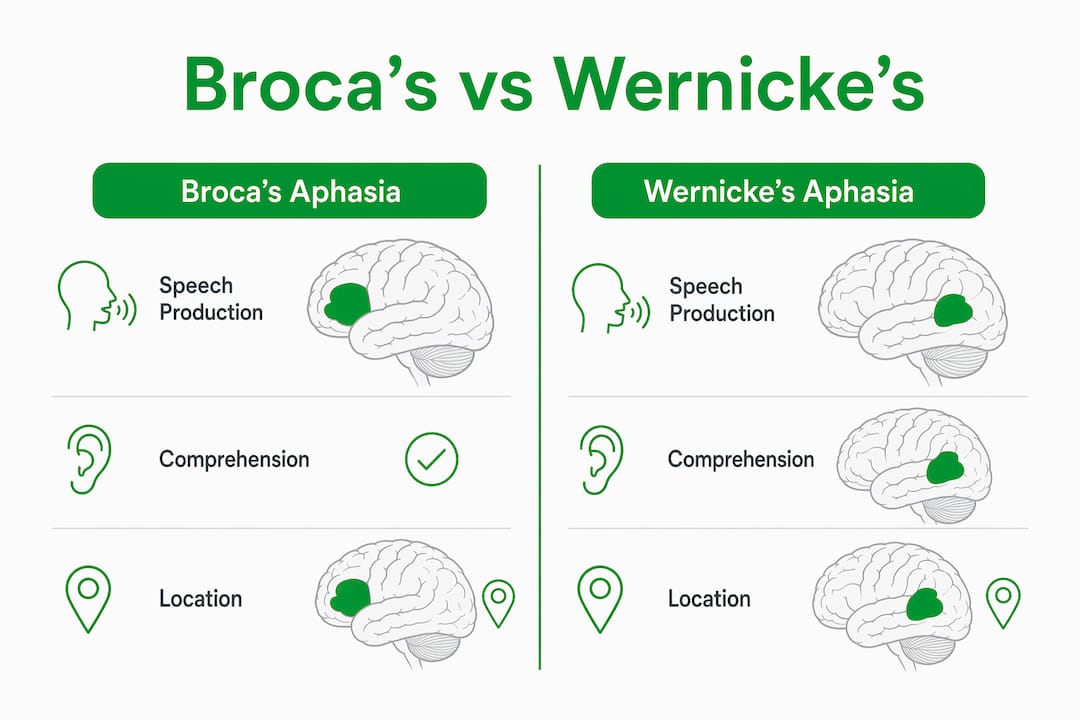
Wernicke’s area occupies the temporal lobe, in the posterior superior temporal gyrus, known as Brodmann area 22. This region processes incoming language and gives words their meaning. Damage here means that spoken words, including the person’s own words, lose their meaning before they can be understood or monitored.
The two areas connect through a white matter pathway called the arcuate fasciculus. This connection is critical for repetition. When the arcuate fasciculus is damaged, a person cannot repeat phrases even when they can speak and understand to some degree. Clinicians use repetition tests as a key diagnostic tool to differentiate aphasia types.
| Feature | Broca’s area | Wernicke’s area |
|---|---|---|
| Location | Frontal lobe (BA 44, 45) | Temporal lobe (BA 22) |
| Primary function | Speech motor planning | Language comprehension |
| Aphasia type | Expressive (nonfluent) | Receptive (fluent) |
| Speech output | Short, effortful phrases | Fluent but meaningless |
| Comprehension | Largely preserved | Significantly impaired |
Around 90–95% of people have both Broca’s and Wernicke’s areas in the left hemisphere. This is why strokes affecting the left side of the brain so often cause aphasia.
Pro Tip: Modern neuroscience recognizes that language involves a wide network beyond just these two spots. Your loved one’s symptoms may not fit neatly into one category, and that is completely normal.
Living with Broca’s or Wernicke’s aphasia means facing a different communication challenge every day. Aphasiastudio was designed by a speech-language pathologist specifically to support that daily work.
The aphasia practice app offers structured exercises for both speech production and auditory comprehension, so whether your loved one struggles to find words or to understand them, there is targeted practice available. Exercises are built to be accessible, low-pressure, and repeatable, which is exactly what consistent recovery requires. You can also browse the aphasia resources list for curated tools and supports that complement therapy. Aphasiastudio is here to help you build a practice that fits real life. Start with the full list of free aphasia exercises.
Broca’s aphasia impairs speech production but preserves comprehension, while Wernicke’s aphasia impairs comprehension but preserves fluent speech. The key distinction is whether speaking or understanding is the primary challenge.
Yes. When damage affects both areas or the pathway connecting them, a person may show mixed symptoms. This is sometimes called global aphasia when both production and comprehension are severely impaired.
Wernicke’s area is responsible for monitoring the meaning of language, including one’s own speech. When it is damaged, the internal feedback loop breaks down, so the person cannot detect that their words are jumbled.
SLPs assess fluency, comprehension, and repetition ability. Repetition tests are especially useful because impairment in the arcuate fasciculus, which connects Broca’s and Wernicke’s areas, produces a distinct pattern that helps differentiate aphasia types.
Recovery varies for both types and depends on factors like lesion size, age, and therapy intensity. Neither type guarantees a better or worse outcome. Consistent, tailored therapy gives every person the best chance at meaningful progress.
🖨️ Before you go — free flashcards
20 picture cards. Print them at home. Practice every day. Plus a bonus workbook preview.