
Exercise guide
Practice now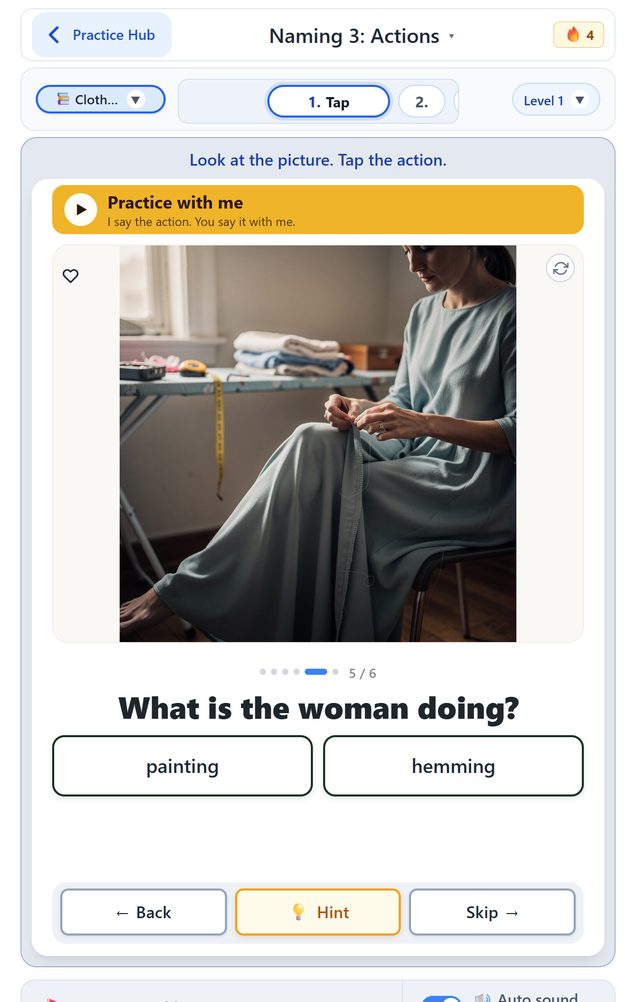
Who it is used with
Actions are often harder to name than things, and verbs are what sentences are built on. Action naming is often used with:
New to it? Naming 1: Pictures first, then come here. Start in Tap mode.
How to use it
A scene and a question appear
Someone is doing something. The question asks: What is the woman doing?
Tap it, say it, or type it
Which one depends on the mode. When you speak, drink, drinking and drinks all count.
Tap Next
Or Skip to move on. Nothing is lost. After 10 actions the set is done.
Modes
The 1 · 2 · 3 strip above the picture switches the mode. Your choice is remembered.
Tap
Easiest. Tap the action: folding, pouring. Two answers on Level 1, three on Level 2, four from Level 3.
Say
Say the action out loud. Tap the green Tap to speak button. Works in Chrome and Safari.
Type
Type the action in its plain form: drink, not drinking.
Ways to get through it
When the action will not come, there is help on the card.
Hint
One clue at a time: who does it and where (for some actions), a sentence with the action missing, the first sound, the letters one by one, then the whole word.
Practice with me
The exercise asks the question, says each clue out loud, and says the action with you. Tap the picture when you have said it.
Levels
On Auto, the exercise moves you up when a set goes well. Or pick Level 1 to 4 in the Level menu. In Tap, higher levels give more words to choose from.
Topics
Tap the topic button to practise actions from your real life: cooking, cleaning, getting dressed.
The method behind it
Confrontation naming with a cueing hierarchy. An evidence-based approach speech-language pathologists use in the clinic: name the picture, and when the word will not come, get a cue, the smallest one first. Read how it works →
What comes after naming actions?
When actions feel easy, put them in sentences: