
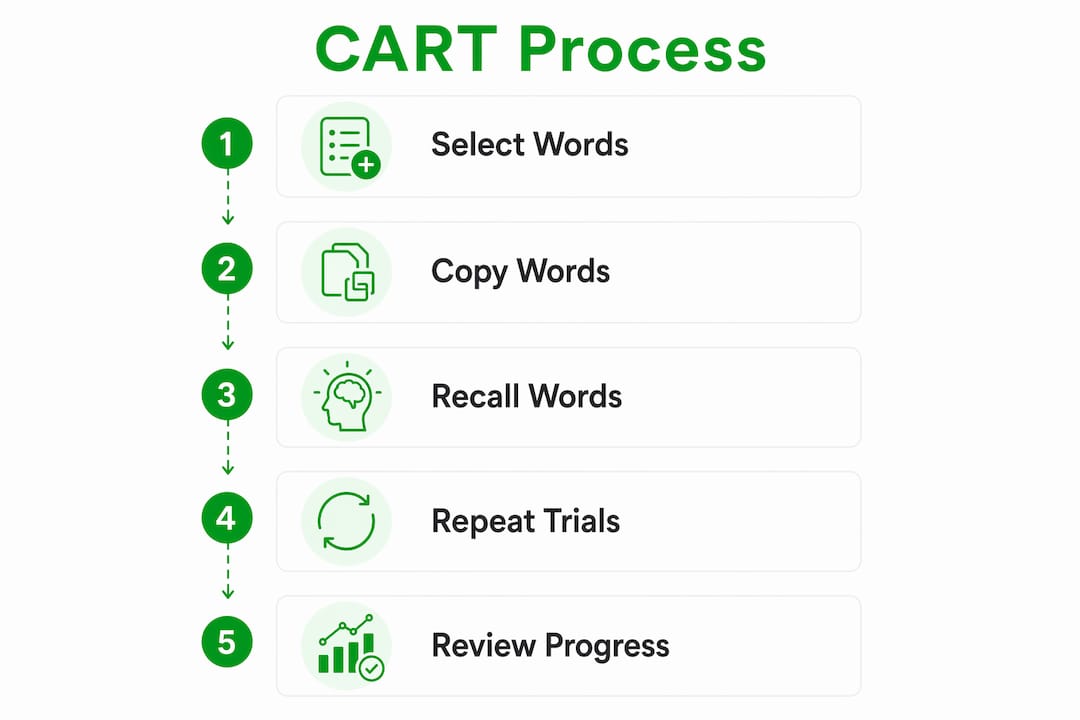
Copy and Recall Treatment, known clinically as CART, is an evidence-based lexical-semantic protocol that strengthens orthographic representations and improves single-word writing, naming, and reading in individuals with aphasia. If you or someone you love has experienced a stroke or brain injury, words can feel just out of reach. CART gives you a structured, repetitive path back to them. The protocol works by having you copy a target word from a visual cue, then hide that cue and write the word from memory. Speech-language pathologists deliver it clinically, but home practice is where real progress compounds.
CART is defined as a writing-based memory recall therapy that targets the brain’s stored knowledge of how words look and are spelled. The protocol activates lexical-semantic pathways by pairing visual input with active retrieval. Each time you copy a word and then recall it without looking, you reinforce the neural connection between the word’s meaning and its written form. That repetition is the engine of recovery.
The technique draws on the same principle behind spaced retrieval practice used in cognitive rehabilitation. Copying alone is passive. Recall is active. The combination forces the brain to work harder, which produces stronger, more durable learning. For stroke survivors with acquired dysgraphia or alexia, this distinction matters enormously. Passive exposure to words rarely produces lasting change. Active retrieval does.
CART is not a single exercise. It is a structured protocol with defined trial counts, stimulus types, and progression criteria. Speech-language pathologists design individualized word lists based on what matters most to each person, whether that is writing a grocery list, signing a birthday card, or texting a grandchild. That personal relevance is what separates effective CART from generic copying exercises.
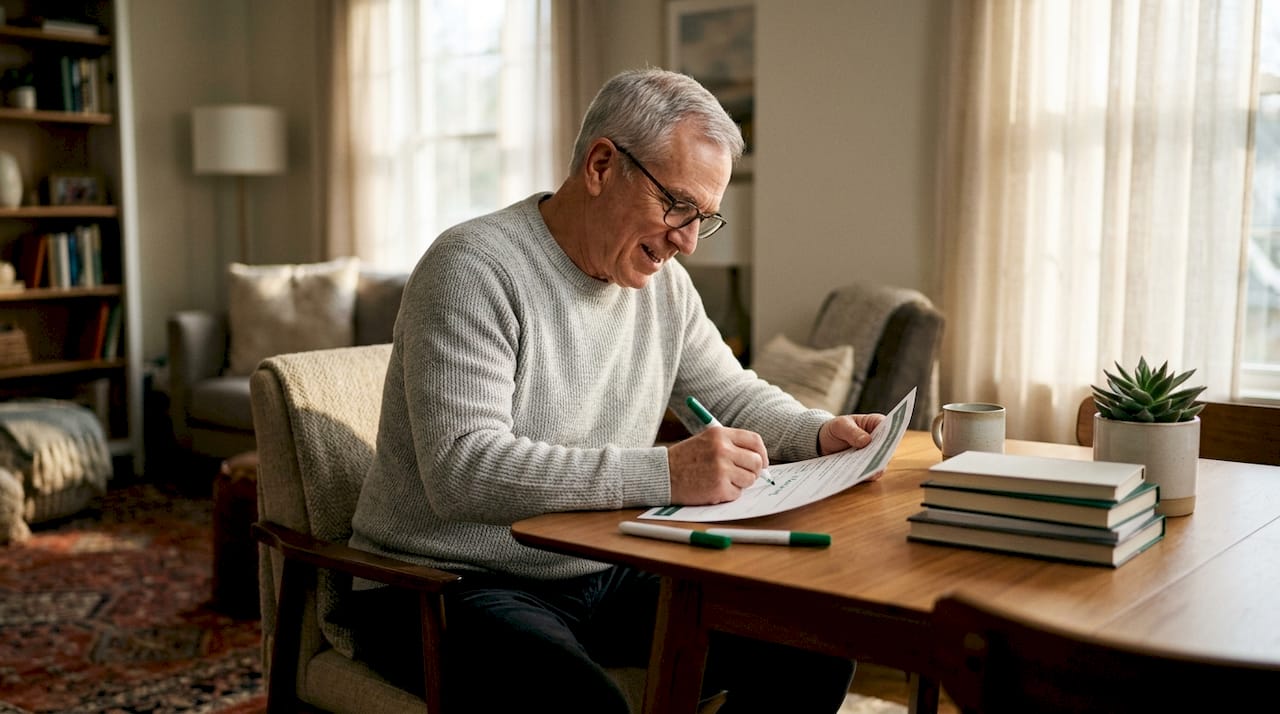
The right materials make practice easier and more consistent. You do not need expensive equipment to start. The core requirement is a set of target word stimuli, either pictures paired with written labels or written words alone, plus a surface to write on.
Different modalities work depending on your motor skills and personal preferences. Someone with strong fine motor control may prefer handwriting on printed sheets. Someone managing hand weakness after a stroke may find a stylus on a tablet or typing on a computer more accessible. The modality matters less than the consistency of practice.
| Writing method | Key benefit | Limitation |
|---|---|---|
| Handwriting on paper | Low cost, widely accessible | Difficult with significant hand weakness |
| Typing on a computer | Reduces motor demand | Requires basic keyboard familiarity |
| Stylus on a tablet | Combines handwriting feel with digital support | Requires a compatible device |
Target words should connect to your daily life. Words like “coffee,” “doctor,” “family,” or your own name carry more weight than abstract vocabulary. Functional words generalize faster because you encounter them outside of practice sessions. Keep your word list short at first, around 5–10 words per session, and build from there as accuracy improves.
Pro Tip: Print your stimulus cards in a large, clear font. Visual clarity reduces the cognitive load of reading, so more mental energy goes toward the recall task itself.
After years of working with people who have aphasia, the thing that surprises most families is how much the word list matters. I have seen people disengage from CART completely when the words felt arbitrary. I have also seen people practice with remarkable persistence when the words connected to something they cared about deeply, a grandchild’s name, a favorite restaurant, a phrase they used to say every day.
The protocol itself is straightforward. The art is in the selection. When I work with someone, I spend as much time on the word list as I do on the mechanics of the session. A technically perfect CART session with the wrong words produces far less than a slightly imperfect session with words that matter.
The other thing I want caregivers to hear is this: your patience during the recall step is a clinical intervention. Waiting those 10 seconds without jumping in is genuinely hard. It feels unkind to watch someone struggle. But that struggle is where learning happens. The discomfort of retrieval is the mechanism of change.
Plateaus are real, and they are not failures. They are signals to adjust. Change the words, add a phrase, shift the modality. The brain responds to novelty. Staying curious about what the next step looks like keeps both the person with aphasia and their caregiver engaged through the harder stretches of recovery. You can also explore integrated therapy approaches when CART alone feels like it needs a complement.
— Lyda
Practicing CART consistently at home is easier when you have the right digital support behind you. Aphasiastudio is an online aphasia practice platform designed by a speech-language pathologist, built specifically for people with aphasia and their families.
The Aphasia Studio's spelling and writing exercises give you repetition-based writing and recall practice that align directly with the CART protocol. You can practice at your own pace, track your progress, and work through word lists tailored to daily communication. For families ready to take the next step, register free at Aphasiastudio and explore tools designed to make home practice feel manageable, purposeful, and worth showing up for every day.
CART stands for Copy and Recall Treatment. It is an evidence-based protocol that uses repeated copying and memory recall of written words to improve spelling, naming, and writing in individuals with aphasia.
A standard CART session includes over 30 trial opportunities. These trials rotate through a short list of functional target words rather than drilling a single word repeatedly.
Yes, CART can be practiced at home, especially with caregiver support. Clinical guidance from a speech-language pathologist helps design the word list and monitor progress, but the daily practice itself is well-suited to a home setting.
In published CART studies, participants who practiced daily typically showed gains on their trained words over several weeks, with carry-over to untrained words and functional writing developing more slowly. Timelines vary a great deal from person to person.
Anagram copy and recall treatment is a variation of the standard CART protocol. It adds an anagram-unscrambling step before copying, which provides an additional layer of orthographic processing and can be useful for people who need more scaffolding before independent recall.
**Common questions about CART** **What is the CART protocol?** Copy and Recall Treatment follows a simple cycle: look at the word with its picture, copy it several times, take a short break, then write it from memory. When recall is correct across several tries, a new word joins the set. Short sessions across many days beat one long session. **Can I do CART at home without a therapist?** Yes. CART was designed for independent practice once the word set is chosen. Our free Spelling Practice exercise follows the same copy-then-recall idea, with audio and hints built in — and the aphasia exercises map shows where writing fits with everything else. **Who is CART best for?** CART was developed for people with severe aphasia and limited speech, because writing can become another way to communicate. Ask your SLP whether it fits your goals. Individual results vary.🖨️ Before you go — free flashcards
20 picture cards. Print them at home. Practice every day. Plus a bonus workbook preview.